


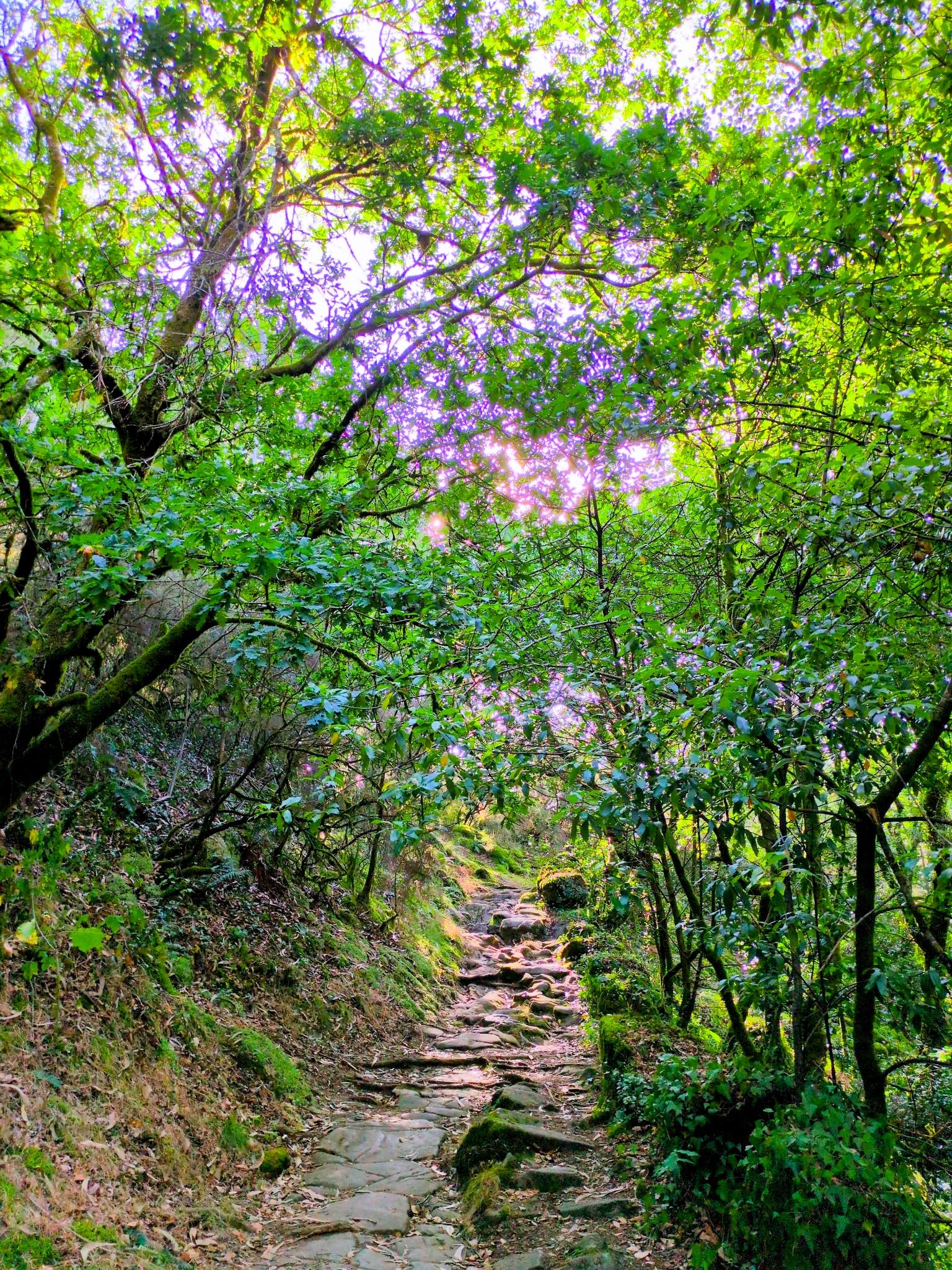
We’re only meters from the crest of a waterfall.
I’m in my swim trunks, peering over the drop. There’s a chilled sheet of water running perpendicular to my tiptoeing feet, rhythmically whooshing. Strangers watch from the oak-shaded pool below, but I stay oriented despite the audience and the blinding glare on my blue blockers. Soon the ferns release my legs and I tread against a shag carpet of moss rounding a curious depression. Mi amigo the Chainsmoker, perched on the boulders behind me, had called this formation the “Jacuzzi” a couple of nights prior, over beers. I hear his muffled crunching of pistachios as I descend.
I announce in spectacularly wrong panic-Spanish that the water is very cold, disturbing what had been an unseen pleasure excursion of a young couple upstream. Shivering and grimacing, I turn away from them and toward my adventuring party, sprawled out under apple trees.
There she is — my love who crinkles a bag of chips while rehearsing for her submersion; the friend who would describe whatever I’m experiencing as a “Jacuzzi” no matter the extent of his English; his girlfriend the Southerner, who teaches us all things Spain, Spanish, and everything else. They smile.
My wife enters the “Jacuzzi,” handing my cap to me so my scalp doesn’t burn. Then the Southerner moseys over and points out the frog who patiently waited by my side through the entire temperature acclimation process. The frog — he meditates on our imitations. I look past our reflections on the water, at mica-speckled stones and pebbles reflecting the sunlight.
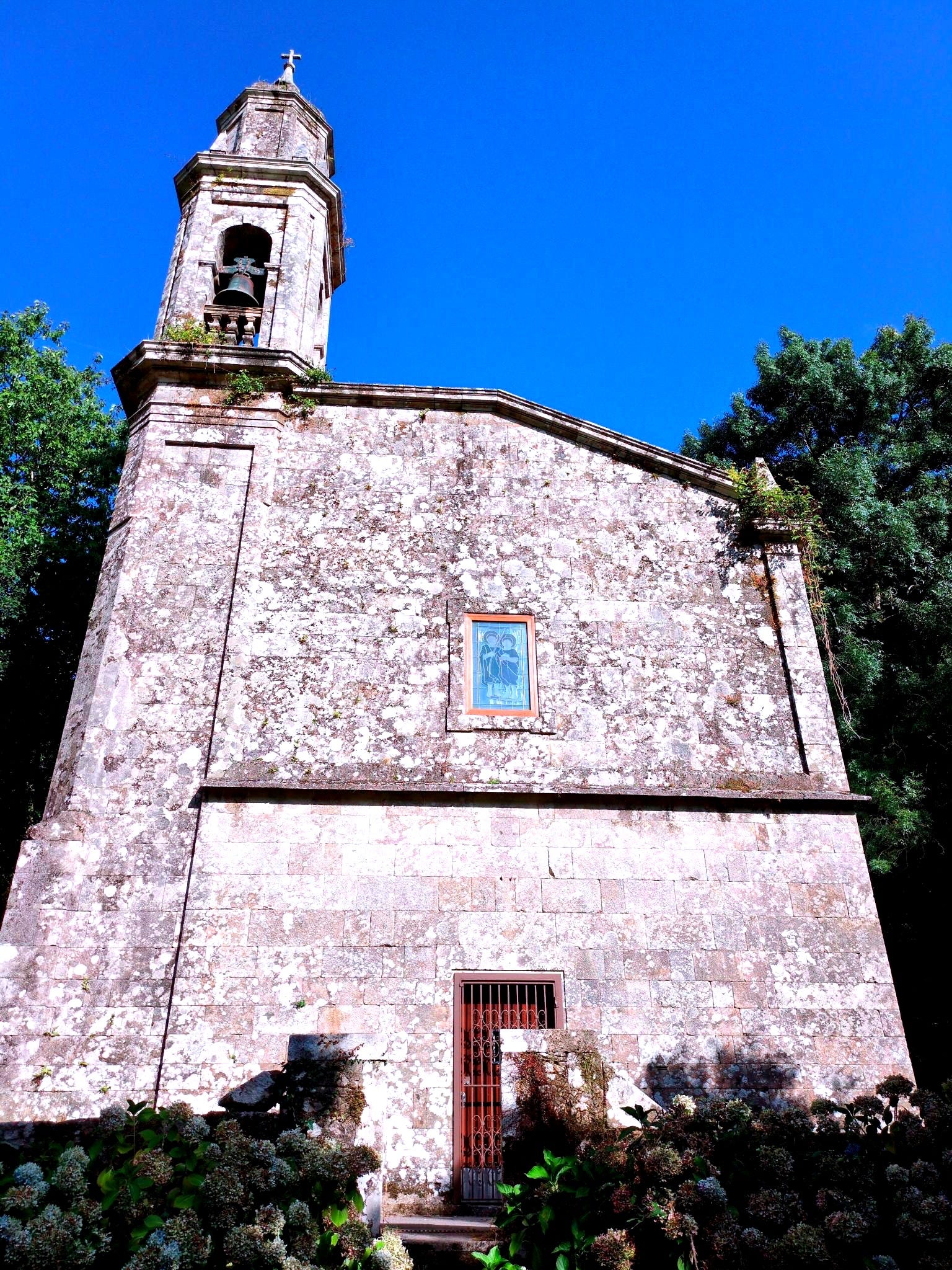
We found our way here on a Camino de Santiago path, remembered only among locals, by hiking past a series of abandoned corn mills; graves tricked out with loud bouquets; a cathedral recently featured in a show about the paranormal; and a defunct bed-and-breakfast monastery. Until some years ago, these spaces were occupied by priests and nuns. Their absence has something to do with a libidinous scandal in the tunnels dug underneath these structures, explains the Southerner as we head back.
Suddenly, moms are crawling all over this riverbank of sputtering dragonflies: moms singing out of tune and dog-moms whose canine children fetch sticks while splashing in the water. One jovial mom — with her sullen gothic human kids in tow — says hola to me, eyeing the laurel leaf tucked between my cap and ear. Hola, I say, straightening it.
True Laurus nobilis, as worn in the wreaths of Roman emperors, is the same plant that gives us edible bay leaves. So saith the Southerner.
She reminds us to take a branch, to dry it properly. Later she asks if we can smell the peppermint. We do; I snatch yet another sprig for la sopa. Then I eat the most savory walnut, the shell of which the Chainsmoker had crushed with zero remorse upon the cathedral steps. I eat a seed-laden berry, and then a succulent purple flower. The Southerner expresses concern that I didn’t sufficiently check for insects nestled within.
“When in Rome,” as they say.
There are no insects scuttling about my tongue, so far as I can tell, but now a blackberry rests upon it, soon to be juiced by an overactive mandible. What a hidden gem this place is, what a buffet for the eyes, skin, stomach, and mind — and the ears too. Over the ridge, there are farmhouses and hórreos with roosters crowing around them. Cock-a-doodle-doo.
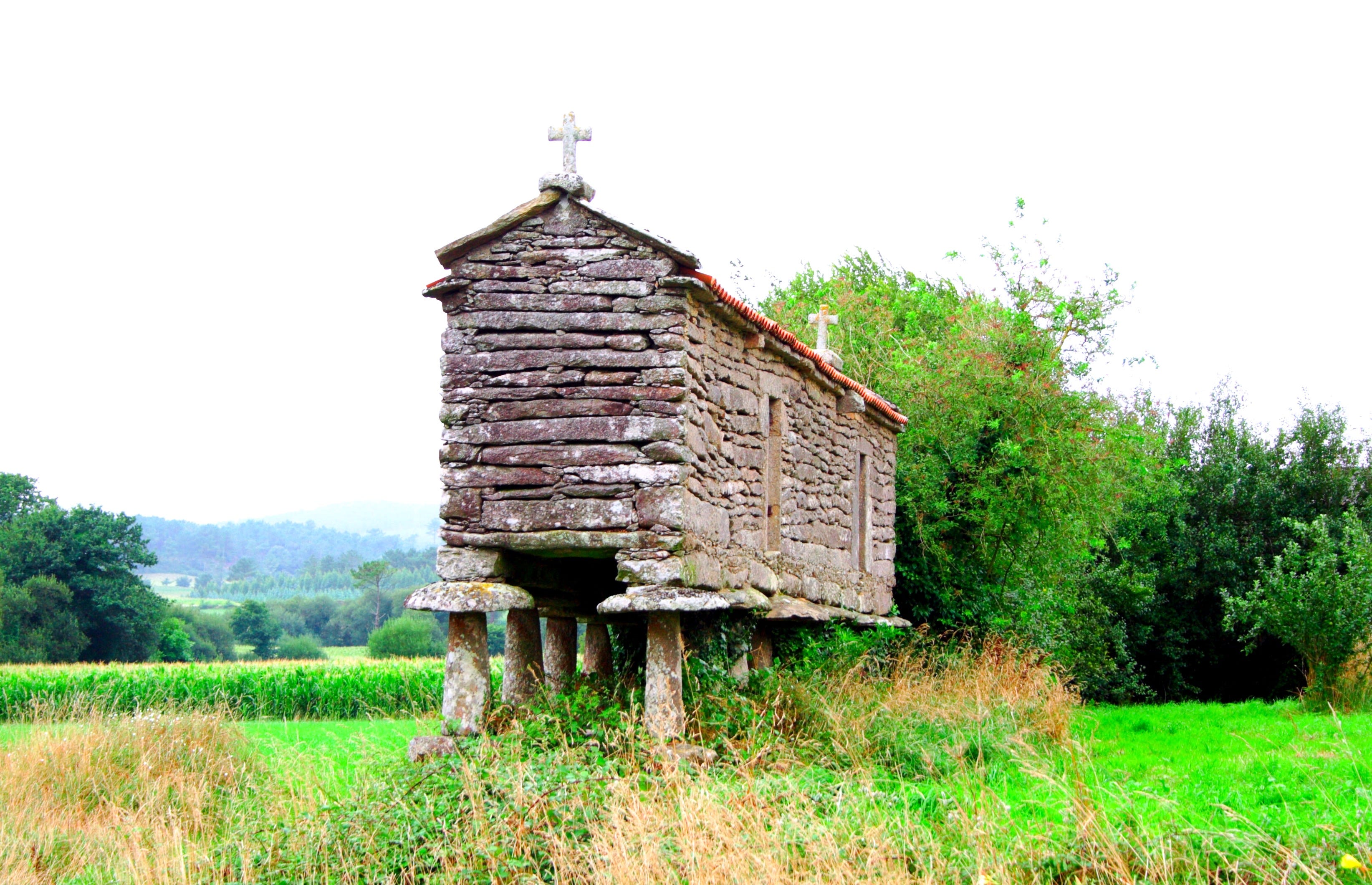

What’s a hórreo?
The hórreo is a narrow structure for storing foodstuffs, usually whatever crop predominates nearby. The building, mostly stone, is raised well off the ground on pillars to deter ratónes and other pests. The eaves of the roof can overhang prominently, because Galician rain is not to be trifled with (especially in the winter). While hórreos are rarely used anymore, municipalities require their preservation for purposes of cultural heritage.
Surrounding the farmhouses there are cornfields that, on the drive to this area and back, remind me of my many years in the Midwest. I also recall my time in the Pacific Northwest, given the hazy mountains all around. Upon them stand gargantuan wind turbines, at which I marvel from dozens of kilometers away on my balcony in Santiago de Compostela. The turbines keep the lights on until I turn them off to look at the Big Dipper instead, or fireworks on holidays, or the occasional concert lightshow.
“Hidden Spain” is most easily reached by car, but my wife and I insist on staying car-free. After all, we have friends with cars. Without friends, I wouldn’t even know where to go outside the city, let alone inside it. I shower them with gifts — regalos — such as booze (not when anyone’s driving) or tacos. There’s a lot of cake involved as well. I expect nothing in return, because these are routine tributes to Bacchus, whom the ancient Greeks called Dionysus.
Our amigas y amigos revel in our joy when they take us along for the ride; we revel in theirs up until I spoil a romantic moment while the sun’s rays reflect off my pallid torso, blinding any and all who would dare to behold a sunscreen-coated vampiro.