

Isolation, Dislocation: When Millennials Leave America
How doing everything 'right' can be wrong.


Shortly after my wife and I moved into our mortgaged condo in the Chicago suburbs back in 2022, someone asked us, unironically, if we had purchased the unit in cash.
“Uh… no,” we replied.
The interlocutor spitefully noted that our inability to buy an absurdly inflated home outright was a lamentably poor financial decision. It turned out this real-life sleep paralysis demon never held a job, having inherited multiple homes before the turn of the century. I wouldn’t care to point that out had it not been for the continuing passive aggression regarding matters… that were nobody’s business but our own?
I sometimes wonder if recurrent encounters like this forge the prevailing psychotypes for those who emigrate. Older publications on the subject tended toward the autobiographical, warts and all. This is an approach I’ve come to appreciate for its earnestness, established before the cynical grift of engagement farming redefined public discourse. Today, there’s a tendency to frame those who move abroad as a faceless mass of goofballs who don’t plan ahead, but…
Stereotypes don’t move abroad! Individuals do. To demonstrate…
Her
Eastern Europe is where my wife was born. She therefore has the right to live in any EU member state. As her husband, I have the right to accompany her. These are rights, not mere privileges or entitlements. One aspect you have to respect about the EU is that, broadly speaking, it takes such matters seriously. As people who come from a country that routinely wipes its ass with the Constitution it was founded on, the difference is stark.
My wife’s immediate family fled the collapse of the Soviet Union, bringing her to the US in the late ‘90s, back when it was a popular destination. Her parents did well enough thanks to their engineering backgrounds — paid in full by the Soviet Union, I might add. Yet as a first-generation immigrant with limited familial support, my wife faced challenges. She told me that when she was little, she had an accent. The other kids didn’t let her live it down until her English had sufficiently Americanized.
Her saving grace was growing up in Chicagoland. The isolation and dislocation were minimized by her proximity to other Eastern Europeans with similar origin stories. There was some semblance of community. On top of that, she had access to fantastic schools with well-compensated teachers, benefiting from urban amenities I had no idea existed until I met her.
Me
When my wife’s family immigrated to the US, I was living in the Pacific Northwest in a double-wide with ventilation issues, surrounded by blackberry bushes, and only connected to civilization by a gravel road cratered by potholes. I spent an inordinate amount of time beating back blackberry bushes with a stick, and eating the berries of course. While we were in the boonies, I had Legos, video games, and a trampoline to jump on. Whereas my wife’s dislocation came before she could remember much, mine arrived abruptly.
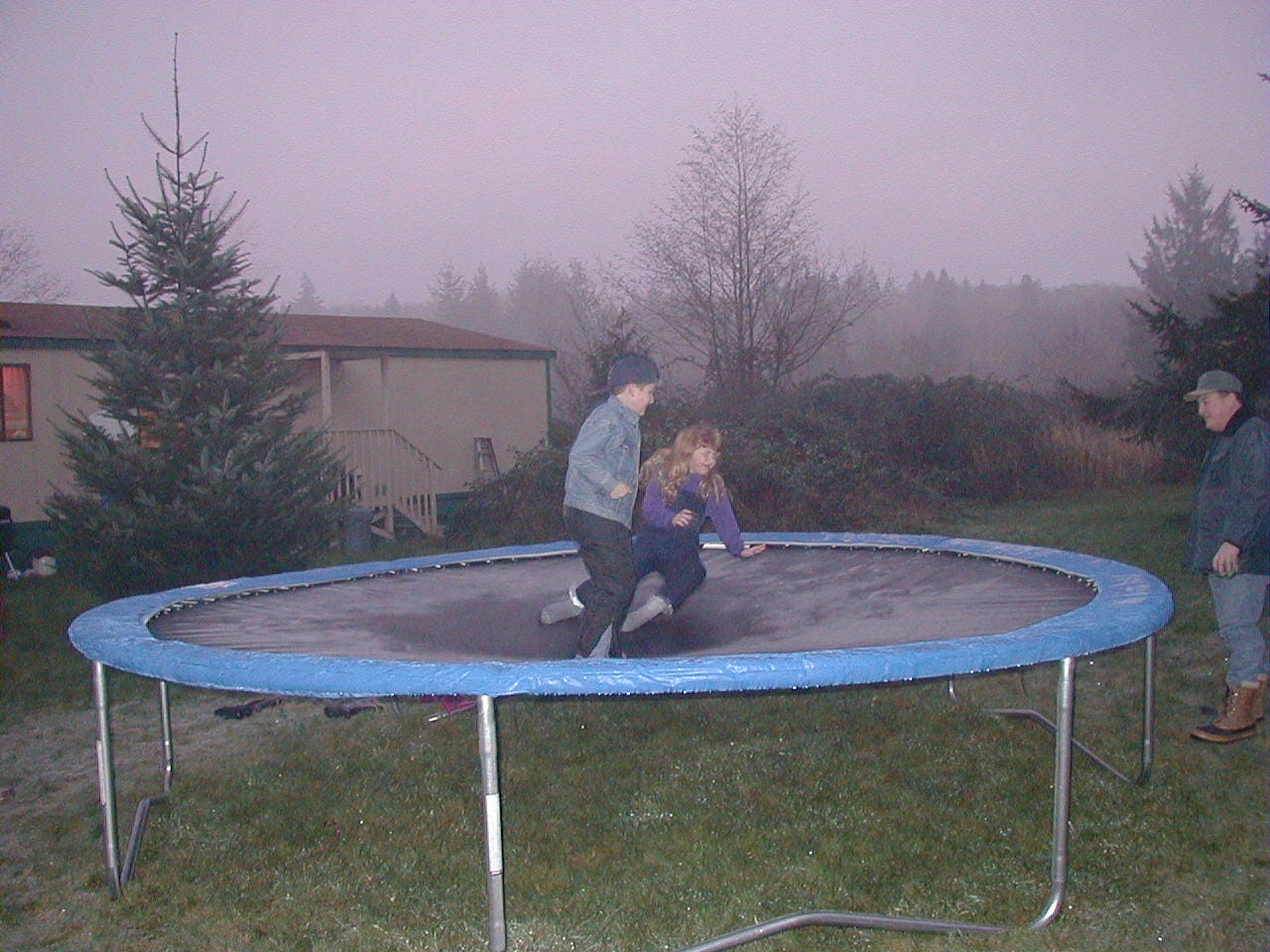
One day I found out we were moving to Southern Illinois. There were financial problems, to put it mildly, so proximity to family could help in a few ways. My mom did a great job raising my sister and me by herself, but I was inherently a bit of a mess.
Some years later, I nearly failed out of high school, but after a concerned teacher pleaded with my dumb ass, I competed — last-minute — in a test on business and computing. I won and received a scholarship that covered most of my tuition at the local community college. At first I was a graphic design major, because I (still) enjoy digital art and animation. However, I changed majors and transferred to Southern Illinois University Carbondale, where I met my wife… before realizing we were in the same computer science program!
Outrunning Burnout
What’s a mortgage, and why did we need one for our condo?
It’s a loan. An equitable arrangement in which you may be permitted to live in a box should you, on a monthly basis, deposit a bunch of money into the pockets of the Monopoly Man, who unilaterally sets the prices. Not everyone grasps the precarity of these loans. The possibility of losing a job or getting sick — both increasingly likely in these trying times and as we age — verges on wrongthink, because so many don’t have a sufficient safety net for the alternative.
After starting our careers, it came into focus that my wife and I were brushing shoulders with people who inherited family friends, networks, and rolodexes. Not to mention material assets, like houses. These individuals were practically built for corporate environments, groomed from adolescence for middle management. We were not. Especially not me.
The reason we as millennials owned anything whatsoever, like a car and some IKEA furniture, is because of our software engineering backgrounds. Because we studied in the right field at the right time, we could pay down debts and eventually save enough to leave. Raises were possible by a willingness to move across states, which necessitated distance from family. I had discovered early on that loyalty to a company far from guarantees reciprocation. We operated on part luck and happenstance, part brute force and ignorance.
We knew, early on, that a system that had us working nonstop the moment we turned 18 was not one in which we’d sustain comfortable lives. As such, we were vaguely under the impression that we would eventually move abroad. Given my wife’s background, we assumed we’d move to the EU. We wanted to slow down to a pace more becoming of people, not cogs in the machine.
We experienced degrees of isolation and dislocation that imperceptibly unmoored us from the US over time. To be very clear: I did not have a horrible upbringing. In fact, I quite liked much of it. My family, I think, has been exceptionally supportive. I was freely given the space to drift, so I did. I experienced densely populated urban areas, and sparsely populated rural expanses — with cats, and hay.

Un-isolating, Un-dislocating
Here in Santiago de Compostela, Spaniards have asked me more than a couple of times: “Why are you here?” Not in a please-leave sort of way, at least not yet, but out of genuine incredulity for why someone would move here in Galicia of all places. Look, I like the rain. Makes me feel cozy. Even so, someone even asked me if I was on a temporary rest stop to Valencia. I responded with my folksy sarcasm(!) by telling them I don’t want to live around the other Americans.
Why are some of my newfound neighbors inclined to discount their home? I think it’s because America has spent decades projecting a very photoshopped image of itself. Low taxes, baseball, big McMansions — with so much shit nobody can even fit their Ford Derpatron Turbo into the garage. My home country pushed the limits of soft power through media and Hollywood, now only ceding the spotlight because it forgot why you need to stay in the good graces of others to survive.
So here we are in the verdant and rain-soaked hills of Galicia, where people puzzle over our bizarre origins. The most thorough explanations I can provide are in the form of long-winded monologues and diatribes, or links to music videos as in the one below. As I develop more fluency in the Spanish language, I’m not even sure I want to pollute it with my American complaints, anyway. Furthermore, I don’t know what will happen in the US. The members of my wife’s family who stayed in Eastern Europe fared far better than her parents did.
I try not to think too hard about what that might imply for us.
Reese here from Bebop Libre: Thanks for joining me. I hope this was more enjoyable or relatable than it was depressing. If you got something out of this post, please like or share it. Isolated and dislocated we may be, but it doesn’t mean we can’t talk about it.