


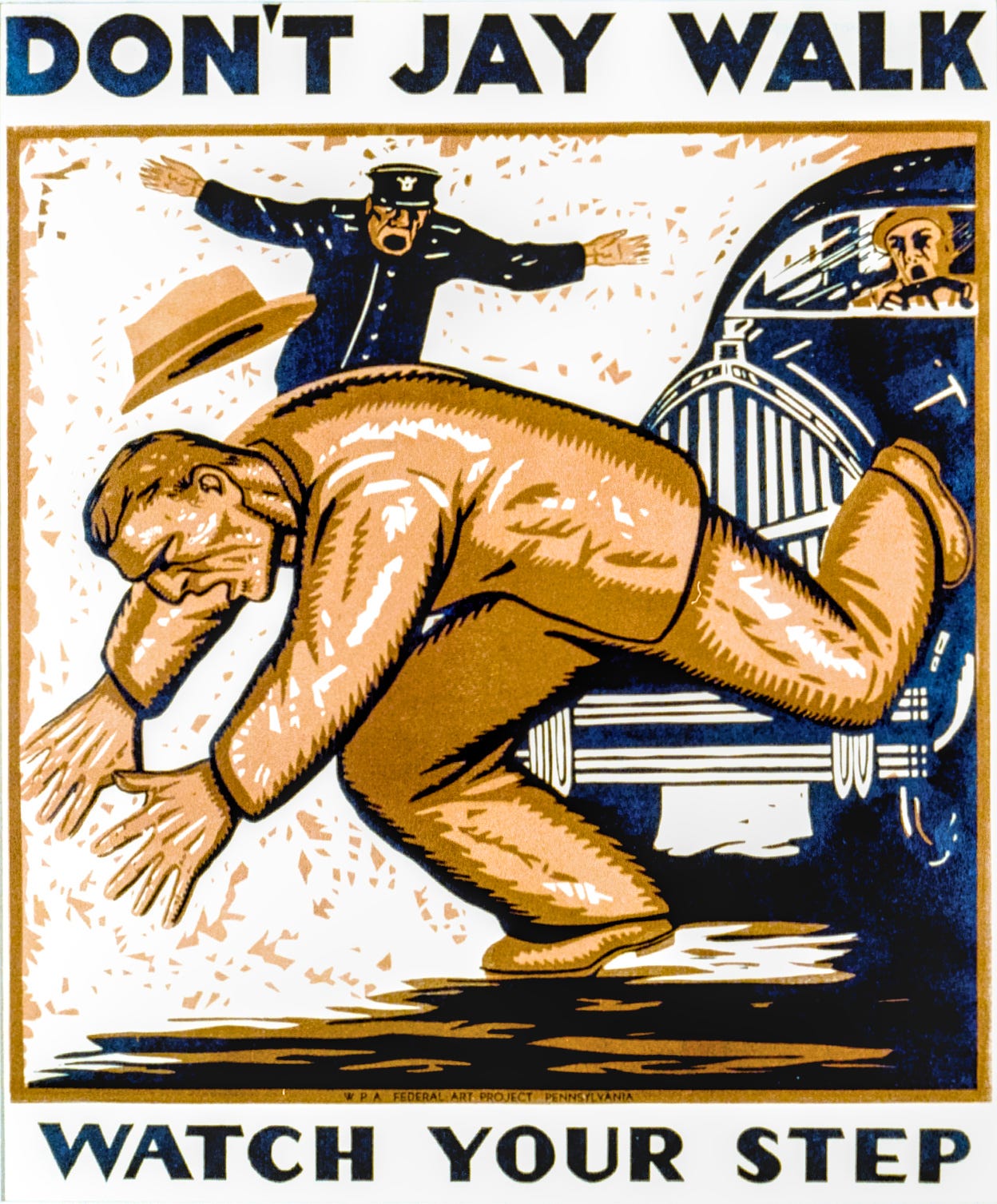

A manager of mine once lamented a problem caused by “employees.”
I wasn’t specifically named, but there was a creeping realization that I might have been part of the problem. The pie chart projected on the wall showed that certain people were doing something wrong: not using the crosswalks into and out of the building. I wouldn’t be surprised if hundreds of thousands of dollars had been lit on fire to study, graph, and report jaywalking. My coworkers and I were, at least, paid to have a meeting about our indiscretions.
How disgraceful: in the parlance of software or user experience design, some of us were using routes that might be called unhappy paths (from our employer’s perspective, anyway). These are cases in which something has gone wrong and needs special handling.
Yet, dodging traffic wherever I pleased was my happy path.
While at a restaurant with friends the other day, I caused a similar catastrophe. What was my happy path was the establishment’s unhappy path. This tension crystallized when I found our waiter suddenly hovering by my side. With his fiendishly dry affect, he began to address me with a stern “Sir.”
Apparently I had used the wrong bathroom minutes prior. In my defense, there appeared to be only the one bathroom based on its placement and exterior dimensions. I paid no attention to the signage because I had not realized that there was another at the far end of the restaurant. The waiter was only informing me, and noted that my use of this single-person bathroom was entirely understandable. He stated, repeatedly, that this happens “nine out of ten times.”
Nine out of ten guys are imbeciles, just like you. It’s fine, really.
What an intriguing comment to repeat. “Nine out of ten times.” With all the sincerity I could assemble, I apologized profusely, much to others’ amusement. Yet, a thought nagged at me. If this is happening the vast majority of the time, then why?
This is the same question I asked when finding out that I wasn’t the only employee who crossed the road without regard for crosswalks. Most of my coworkers did the same. All the time. And it turned out we took the same paths (just not on the crosswalk). There were heatmaps to prove it…
When many people all have the same problem, shouldn’t another cause be found? If the system lets you make the error, it is badly designed. And if the system induces you to make the error, then it is really badly designed.
― Donald A. Norman, The Design of Everyday Things
When users of the road or bathroom or software or whatever overwhelmingly interface with the thing “wrongly,” and predominantly in the same way, design-level reconsideration is called for.
If user expectations are so counter to those of the designer, there are unfortunate possibilities. One is that the designer’s projections of user expectations are off-base. Another is that the designer did not adequately channel the users into, or nudge them toward, a desired happy path. Thus, users frequently stumbling onto the wrong path indicates a design problem. Offloading the solution to “the problem” onto the users themselves is a hallmark of flawed design.
And when the design deliberately manipulates users to stay on a “happy path” that’s unhappy for them personally, there’s probably a dark pattern at play.
By the way, as I turned back to the table after having been disciplined, I swear I heard the waiter utter it again to no one in particular. “Nine out of ten times.”
Obviously, I’m not alleging that the crosswalks or bathrooms as I’ve described were fine-tuned to torment anyone. They weren’t. Not to mention, designs themselves are often constrained and nudged by available resources and stubborn externalities. Therefore, inconvenience is usually not due to ignorance or malice. It’s probably just a downstream consequence of a narrow window of design opportunity. Arguably, then, the root cause of poor design is often another poor design. Perhaps a chain of poor designs. The higher their order, the more prohibitively resistant they are to change. It’s complicated, expensive. That’s why the more all-encompassing a design is, the more prone the entire system is to minuscule failures that cascade into big ones.
One guy not using the crosswalk, or walking into the wrong (unattended) bathroom, is not really a big deal. But when everyone does it, there’s a fuss. So here’s a radical idea: convert the single-person bathroom into a… bathroom. As a friend of mine noted during our lunch, unisex bathrooms are commonplace here in Spain. Another friend and colleague of mine had mentioned, during The Jaywalking Crisis, that crosswalks could simply be painted “where people actually cross the fucking road.”
I still happen to agree.
Nonetheless, over the course of my life, I’ve observed organizations allocating more resources over time to everything but solving the actual problems (the problems that cause all of the other problems). Sometimes, the root causes aren’t regarded as high-priority. Most of the time, the incentives to solve root-cause problems become outweighed by the incentives not to solve them. We live in a society of manufactured problems. Personally, I think this is great. I don’t want the restaurant to solve the problem I complained about. I want to go there again, and—
I want to hassle someone for using the “wrong” bathroom. Not on the basis of gender, which is inconsequential to my entertainment. No matter which bathroom is selected, I’ll be ready to announce the error. “Nine out of ten times,” I’ll say.
Feel free to confound a friend, no matter where you eat together. This trend has the potential to cause so many more problems that people might stop giving a shit about some non-problems. (The food was delicious, by the way.)
What an absolute menace. Who let you into this country? Que horror. 😂
Guess which was my first transit ticket when I moved to La Jolla...