
How the Fuck Has This Nearly 1,000-Year-Old Cathedral Not Sunk into the Ground?
On Galicia's geological jackpot.

Part of Bebop Libre’s Spainfrastructure series. 🚆

In the Spanish and Galician languages, this medieval marvel is called the Catedral Basílica de Santiago de Compostela. Construction began in 1075, but the structure wasn’t “consecrated” until 1211 — basically, the equivalent of a religious ribbon-cutting ceremony.1
This shrine to the apostle James, patron saint of Spain, is where nearly half a million pilgrims now converge each year.2 There are numerous routes spanning the interior of the country and exterior: namely, in Portugal and France. People like my aunt tend to have a wonderfully intoxicating time on the Camino de Santiago pilgrimage — the Way of Saint James.
It just so happens that Santiago translates to “James.” Not “extended bar crawl.” Don’t tell my aunt that, though, and definitely don’t tell her about this blog post.
Nonetheless, throughout these lands there’s an abundance of vino (wine) to accommodate every kind of aunt on her debauched pilgrimage: those who prefer vino tinto (red wine), and of course who can forget the ones with a hankering for vino blanco (white wine)? Aunts into cerveza (beer) won’t be disappointed either. And for aunts who don’t partake, there’s always agua (water) and Pepsi (Pepsi 😉).
Let’s get some things straight…
Having nearly failed three years of Latin in high school, I’m uniquely unqualified to opine that the meaning of compostela is less certain than Big Santiago would like you to believe.
To my Latin teacher, Ms. May: Just trying to redeem myself for that time I used your color ink to print a picture of my face superimposed over Ash Ketchum’s body.
It’s often repeated that compostela means “field of stars,” deriving from the Latin campus stellae (field of the star)3 or campus stellarum (field of stars). The folklore goes that a shepherd saw weird lights loitering over a field (probably aliens), and thus found the namesake apostle’s tomb. Yet, compostela more likely derives from compositum (burial ground), or composita (cemetery).4 As compostela is a diminutive form of those words, implying a sense of smallness, it might mean “little cemetery.”
“James of the burial ground” doesn’t sound as cool as “James of the field of stars.” Of course, both could be true. Wordplay isn’t a modern invention. Why couldn’t it be, “as above in the stars, so below in the grave?” I’m unable to keep my Hermetic dictum in my pants.5 Sorry.
Loamy burial grounds aren’t generally known for being able to support structures weighing roughly one hundred goddamn thousand metric tons.6 That is, 220 million pounds. Around the weight of a Nimitz-class aircraft carrier.7
But before we dive into how this is physically possible, let me address the proverbial elephant in the room…
Most people have a spiritual awakening when gazing upon the Santiago de Compostela Archcathedral Basilica. When I moved to Santiago de Compostela with my wife — I did not. In my critically-acclaimed and groundbreaking piece, “Moving to Spain: Holy Sh*t, Is That a Tarantula?,” I recount my first encounter as such…
The cathedral’s gravity began to pull us closer. We experienced a street performer going hog wild on the bagpipes in an ode to the Celtic origins of our adopted city. Then we limped past pilgrims of the Camino de Santiago whom bystanders were clapping for. Why, you might ask?
They were at the completion of a long sojourn, a spirit journey that can be weeks or even months in the making. That contrast between me, being an excruciatingly furrow-browed dickhead, and the starry-eyed pilgrims, shedding tears, was not lost upon my deranged and fragile psyche.
Most people see an ornate monument of historic significance; I see a mass composed of matter. We are not the same.
That’s why I can produce articulate thesis questions capable of betraying the comforting retreat of our spiritual kinship: How in the fuck is this thing not sinking or leaning? It constantly rains here… are the stone buildings and corridors sinking as one hulking contiguous mass? Are there ongoing and publicly invisible efforts to lift this bad bitch with hydraulics? Is this beautiful fairytale city actually a simulation orchestrated by my final neural impulses?
The answer, my hombres, will be revealed. Soon.
But first — when cathedrals go wild. 👺
This wouldn’t be a Bebop Libre-certified shitpost without going down a distracting, tangential, and self-indulgent rabbit hole that pisses off readers from all over the world. Even you. May I redirect your attention to the cathedral from Hell?
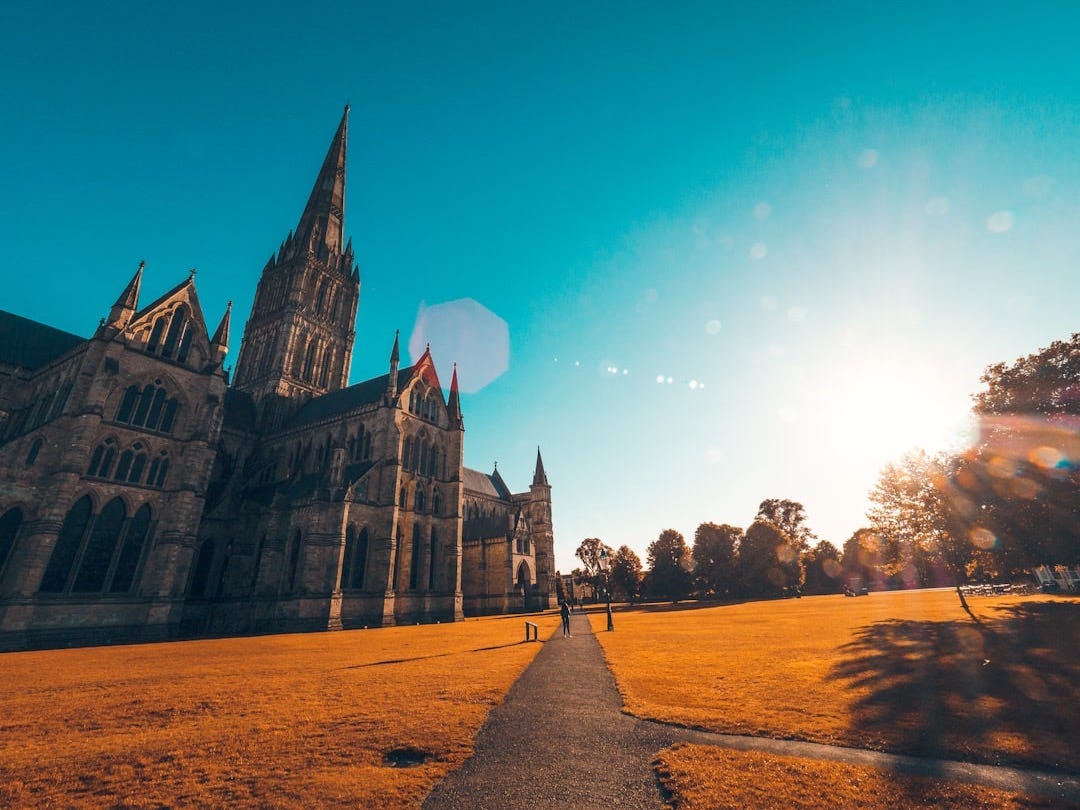
It’s called Salisbury Cathedral.
Construction began in 1220. Consecration? 1258.8 It doesn’t outwardly appear evil. However, any structural engineer of repute would tell you this is merely a sinister facade (hehe).
Join our research initiative: Lead scientists at Bebop Libre have developed a novel theory that targeted advertising on social media becomes muddled at the sites of engineering-challenged buildings like the Leaning Tower of Pisa. Our research division respectfully asks you to leave a comment on this post if you notice — while doomscrolling in the bathroom — more erectile dysfunction awareness ads than we know you usually receive based on our market research.
Now, before we get into the engineering challenge of maintaining Salisbury Cathedral, I want to emphasize: I’m not a real engineer, even though I call myself a software engineer.
It’s a euphemism for “code monkey,” obfuscating that I have no idea what I’m doing in both a technical and ethical sense, just like the rest of my “colleagues.” We love pretending to be engineers, as the title conveys some sort of certification, vetting process, or basic scientific fluency that is rigorously maintained over the course of an enriching career. But — if there’s anything I’ve proven in mine, it’s that I’ve a penchant for hyperfixation whereby I provide no tangible utility whatsoever.
Case in point: cathedral load-bearingness.
In an article titled “The miracle of Salisbury Cathedral,” Jerry Everard of The Fog Watch details the problem, or miracle as he frames it. Quoting him:
The foundations of the cathedral are only 28 inches (just over 700mm) deep and built on a barely drained swamp. They were not built to withstand the additional 6,500 tonnes supplied by the spire. Slowly but surely the spire moved out of alignment . . .
Unsurprising for Britain’s longest medieval spire.9 (For all of Europe, it’s the second-longest behind Strasbourg Cathedral in France.)10 Everard furnishes photographs documenting the bend in the spire’s erection, and he also points out a curious hole exposed in the floor ( ͡° ͜ʖ ͡°). He explains that it was dug to measure the water level underneath the cathedral’s foundation twice per day with a dipstick… so because of this tenuous situation, Salisbury Cathedral has needed extensive repair to prevent its collapse.
Water-based dilemmas are not uncommon in rainy locales such as England. Salisbury is near Southampton, which sustains ~819 mm of annual rainfall on average.11 As for Santiago de Compostela? ~1,900 mm.12 And I daresay England isn’t drowning in nearly as much vino as Galicia. Cerveza, however, is debatable.
Again — how is it that Santiago de Compostela’s famed cathedral hasn’t yet sunk or floated out into the Atlantic all without a yearly US defense budget being spent to prevent such a calamity? It’s relentlessly pummelled with rain. And we’ve every reason to believe it was built on a haunted burial ground visited by aliens.
Probably the same ones who manipulated our DNA.
The answer lies within.
So, where was all of that granite sourced from to build Santiago’s famed cathedral? Did the builders simply ask the aliens to do them a solid? The following is a dramatization of what might have occurred in the fateful years preceding its construction…
HUMAN: “Hey, aliens.”
ALIEN: “Shit, that one can see us. Uh, so we’re not actually extraterrestrials.”
HUMAN: “Ah, semantic deflection. You’re cryptoterrestrials, aren’t you? Those silly biosynthetic humanoid avatars 3D-printed from deep within the ocean?”
OTHER ALIEN: “…Er, why’s he speaking modern English, man?”
HUMAN: “I’m a time-traveler.”
OTHER ALIEN: “Fuck, man. This is bad.”
ALIEN: “Dude, you can’t just insert yourself into your own history like that. You’re gonna do something you’ll regret and create a time rift that will seriously confuse a 20th-century author named Kurt Vonnegut. Go back to your own time.”
HUMAN: “Oh, I’m sorry… I didn’t realize the Prime Directive applied temporally, and not spatially.”
ALIEN: “…What do you want, you little asshole?”
OTHER ALIEN: “I’m freaking out, man.”
HUMAN: “I’m gonna need you to tractor beam some construction materials over here for a cathedral I’m gonna use to control my kind with religion in the future, you know, like in a Dan Brown novel. Unless of course you want me to ping the Galactic Federation right now.”
OTHER ALIEN: “He’s blackmailing us, man!”
GHOST OF SAINT JAMES: “HAHAHAHAHAHAHA!”
ALIEN: “We were just refilling our heme iron reserve from these cattle. I know what it looks like, but we were not doing anything untoward with them.”
HUMAN: “Mmhmmm. You reek of sulfur.”
ALIEN: “Look, I scanned the haunted burial ground below you. The apostle James was laid to rest down there, hence why his ghost is presently mocking us, and there’s also a Variscan massif — that is, an antediluvian sheet of metamorphic rock. You should know that since you’re from the future. Dig a quarry, douchebag.”
OTHER ALIEN: “Quick, manipulate his DNA!”
Again, I need to stress that this is a dramatization. There’s no credible evidence of anything portrayed in this scene except for the “Variscan massif.” This refers to a zone of raised and erosion-resistant rock formed in the Paleozoic continental collision that transpired roughly 290-370 million years ago.13 Northwestern Spain lies atop an enormous so-called “crystalline basement” — related to the Appalachian formations I’ve seen exposed in road cuts while driving on I-40 through Tennessee, remnants of the same mountain chain before the Atlantic Ocean opened for business.14 But that part of it was deliberately drilled, blasted, and mucked out for vehicular travel.
Before our continents distinctly separated as we know them, thus ending their geologic bromance, they formed one to rule them all — Pangaea — where a single, connected Variscan belt once ran unbroken.
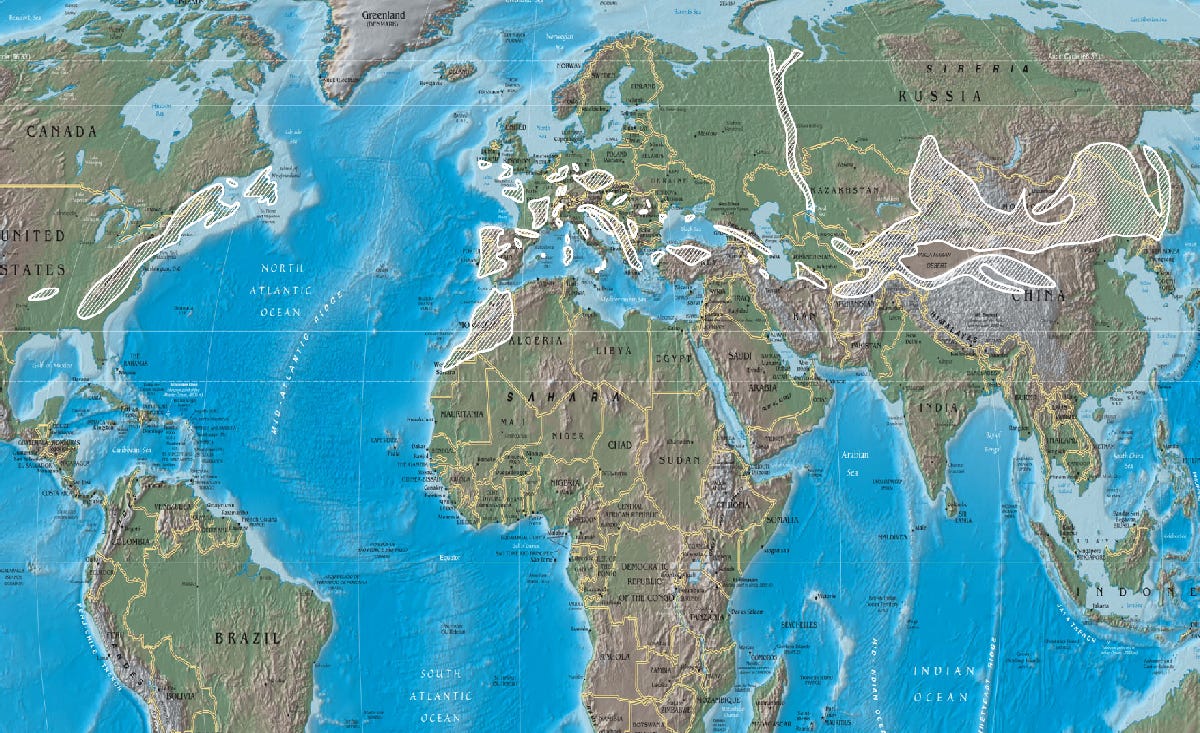

What geologically distinguishes the western Iberian Peninsula is that its crystalline basement and chunk of Variscan belt are naturally exposed to a significant degree — but especially in Galicia, because of its tectonically uplifted and erosion-resistant rock. Thus, the Galician granite sourced for the Santiago de Compostela Archcathedral Basilica differs little from the bedrock of the landmass it rests upon. Water doesn’t penetrate the granite; it runs right off.
Basically, Galicia is like a massive granite tabletop.
The rain? It’s mainly a concern for those living here, not for granite-based cathedrals. Weathering is certainly an issue for decorative elements, which do require ongoing maintenance, but it’s far harsher on less resilient materials. Having been embedded in an ancient Roman (and granite!) aqueduct, take for example the statues of the Virgin Mary and Saint Sebastian in Segovia, which is about 60 miles north-northwest of Madrid. The statues had been hoisted into their respective niches back in 1520. But the rendition of Saint Sebastian was removed in 1972, and the Virgin Mary later in 2019, both due to weathering.
The restored originals can now be viewed in the Casa de la Moneda (Royal Mint) of Segovia. Resin-based replicas were inserted in place of the originals. And they look good,15 but not all restorations have been as well-received…
Limestone is more workable than granite, but significantly less weatherproof. The Santiago de Compostela Archcathedral Basilica’s decorative elements are mostly granite, with some marble. It was constructed and sculpted the hard way, no pun intended, to stand the test of time.
If you enjoyed this Russian nesting doll of tangents, then subscribe to Bebop Libre for more! That’s our specialty. And by “our,” I mean some guy who moved to Spain from America.
History, Art, the Apostle St James, Catedral de Santiago (accessed December 22, 2025)
Statistics for the Camino de Santiago, American Pilgrims on the Camino (accessed December 22, 2025)
Lights and Stars in the Quintana, Santiago Turismo (November 28, 2025)
History of the Camino de Santiago, American Pilgrims on the Camino (accessed December 22, 2025)
Hermeticism: The Ancient Wisdom of Hermes Trismegistus, Eternalised (February 7, 2023)
Assumptions
Dimensions
Width: ~70 meters (includes transepts and side structures)
Length: ~100 meters (includes cloister)
Average height: ~25 meters (varies from walls to vaulted ceilings)
Both towers: ~75 m tall, ~10 m × 10 m base each
Material
Galician granite density: ~2,640 kg/m³
Fill factor
Main structure: ~17% solid stone (walls, pillars, vaults)
Towers: ~25% solid (thick walls but hollow interior)
Calculations
Main Cathedral Body
Bounding box volume: 100 m × 70 m × 25 m = 175,000 m³
Solid proportion: ~17% → 29,750 m³ of granite
Mass: 29,750 × 2,640 = 78.5 million kg
Towers
Each tower: 10 m × 10 m × 75 m = 7,500 m³
Combination: 15,000 m³
Solid proportion: ~25% → 3,750 m³ of granite
Mass: 3,750 × 2,640 = 9.9 million kg
Foundations
Add ~15% guesstimate of the above for the foundation → ~13.3 million kg
Total Estimate
Main body (78.5) + Towers (9.9) + Foundation (13.3) = ~101.7 million kg
Disclaimer: this is a ballpark estimate — there’s much room for refinement, especially for the fill factor.
Sources for cathedral weight estimate:
Width and length: Metropolitan Cathedral Basilica of St. James the Apostle, around.us (accessed December 22, 2025)
Height: Cathedral of Santiago de Compostela, Mundiplus (accessed December 22, 2025)
Material density: Blanco Galicia Granite, StoneContact.com (accessed December 22, 2025)
How Aircraft Carriers Work, HowStuffWorks (accessed December 22, 2025)
Salisbury Cathedral, Smarthistory (accessed December 22, 2025)
Britain’s tallest spire, Experience Salisbury (accessed December 22, 2025)
Strasbourg Cathedral: discover the Gothic masterpiece!, French Moments (June 4, 2025)
Average Annual Precipitation for the United Kingdom, Current Results (accessed December 22, 2025)
Climate in Galicia (Spain), Climates to Travel (accessed December 22, 2025)
Hercynian Orogeny, ScienceDirect (accessed December 22, 2025)
Bedrock geology and mineral resources of the Knoxville 1° x 2° quadrangle, Tennessee, North Carolina, and South Carolina, U.S. Geological Survey Bulletin 1979 (1992)
500 Years at Their Feet, Azoguejo 1520 Project (accessed December 22, 2025)