

The Logos of Moving Abroad: Origins of Urbanism, and Why We Chose Spain — Galicia!
Learn what Diogenes the Cynic, Ulv the Viking, and you might have in common.

My wife and I could’ve moved anywhere in the world from the US, yet in September 2025, we chose the country of Spain, region of Galicia, and city of Santiago de Compostela.
Why?
Well, personal preferences and circumstances are the linchpin.
Moving to a trade bloc that actually upholds social democratic values, the European Union, was most expedient for us given that my wife is an EU citizen. Therefore she has freedom of movement to live and work in any member state. Furthermore, this right extends to me as her husband. Basically, spouses and children may accompany EU citizens so long as residency is sought and requirements are met. For those intent on moving abroad, I recommend getting acquainted with the variety of visa paths throughout the world. Accessibility depends on where you’re at in life. Be aware: time is running out.
Options are diminishing for most people.
Logic, circumstances, preferences
Now, this isn’t a “move to Spain” post… per se.
There’s the EU, but if you’re… abroad-mogging(?), consider going wherever the future is being built. That very much depends on what the future means to you. For example, research strongly correlates financial prosperity with scores on a benchmark called PISA. That’s the Programme for International Student Assessment. So what better place to start a family or business than where people score highest on math, science, and reading?
And by that logic, I should be writing this from Seoul or Taipei, but… just how geopolitically stable are those cities, sitting where they do? What cultural barriers might somebody like me encounter there? What’s “financial prosperity,” anyway? GDP? Lol. Figuring out where to go is a multidimensional process, not just one score.
That’s why we’re building our future in Spain, because the logos of moving abroad isn’t a spreadsheet.
Circumstances may narrow opportunity, but they also provide a trade wind. Preferences provide steering. My wife’s EU citizenship made Europe an easy decision, while East Asia would’ve presented challenges. But if you’re younger, unmoored, have a knack for learning, and lack the EU shortcut we had? Don’t dismiss that part of the world. A language program could be your foot in the door someplace extraordinary.
And whether you call yourself an immigrant, emigrant, or “expat” — and yes, the connotations differ… remember that you’re not moving to a Costco.
You’ll be surrounded by people with real lives and struggles, who need support from anyone who can provide it. That’s why those of us with flexibility might consider spreading out. Cluster into enclaves, snatch up housing stock, inflate costs for locals, dilute the culture with consumerism, and you’ll eventually piss someone off. An added benefit in spreading out is that those of us who do move abroad are more likely to integrate by “immersion therapy,” since the comfort zone of the expat enclave doesn’t apply as readily.
While relating to others who move abroad comes naturally, we must spend more time integrating than we do recovering from the stress of integration.
Integration vs. Diogenes
Wherever one goes, integration is crucial.
It’s stressful, awkward, and, at times, downright humiliating; however, nothing is more enriching than leaving parts of yourself behind to adopt a broader perspective. You’ll be occasionally bullied, but the tradeoff is worth it… hopefully. As we all know, immigrants and emigrants are easy targets. You might be three months into living somewhere and have someone demean your entire existence for merely mixing up one word with another. But it could be worse: where I’m from, immigrants, citizens, and indigenous people alike are detained without warning and deprived of basic human rights for indefinite periods of time, no matter their documentation. Papers, please — or not.
To the contrary, Spain is in the process of regularizing around 500,000 immigrants so they have one less thing to worry about. These are individuals whose lives have not been easy. They’ve remained, perhaps, Stoic?
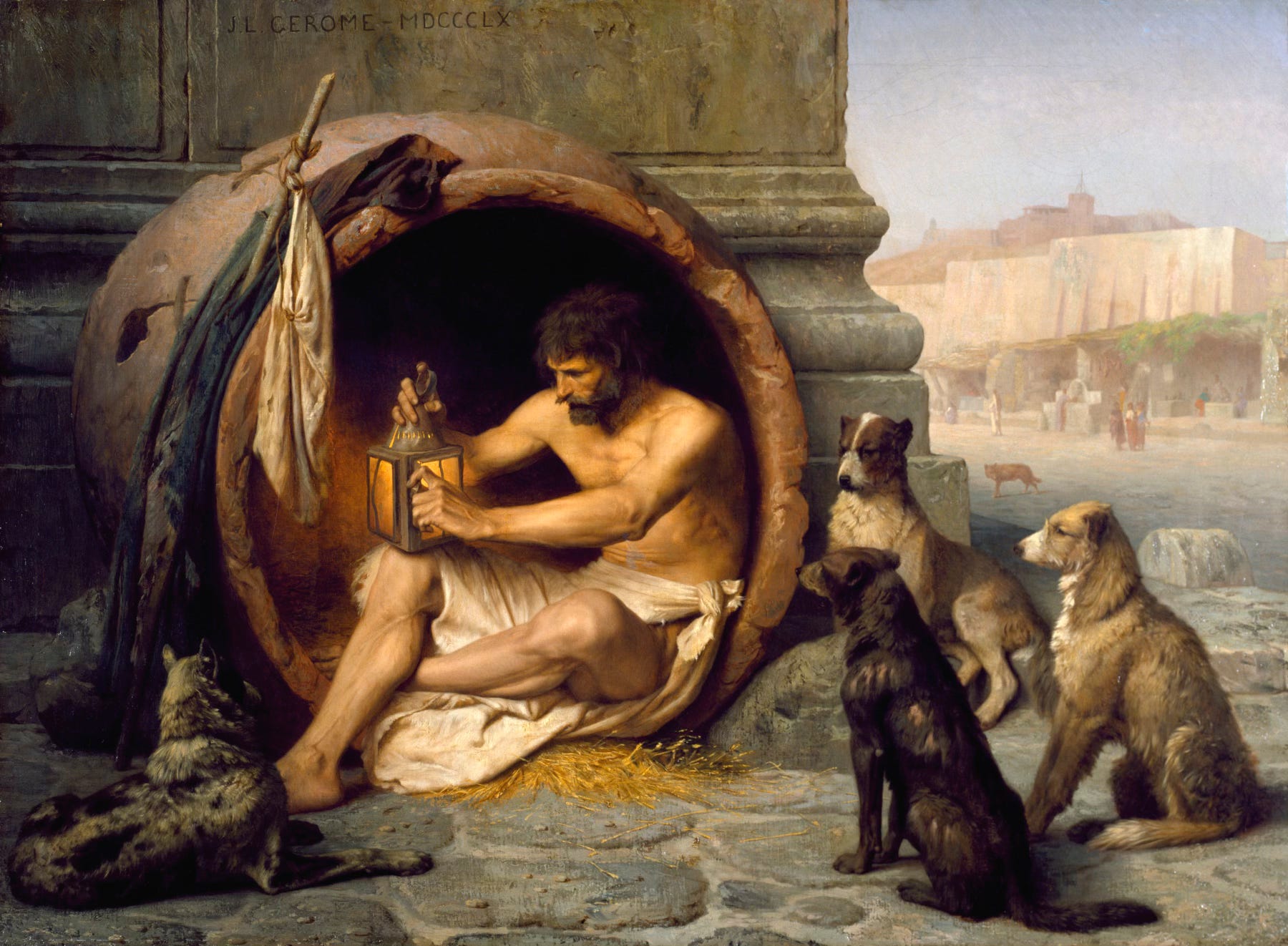
Diogenes the Cynic was an Ancient Greek whose philosophy partially informed Stoicism, the view that our universe is the manifestation of logos… that is, a generative logic as intrinsic to physics as it is to social dynamics. You’re probably wondering, “What the hell? What does this have to do with moving abroad?”
[Twirls mustache] Welcome to my domain.
The thing is, Diogenes was a complete weirdo who lived in a large jar (pithos), wore the least possible clothes, and once told Alexander the Great to go fuck himself directly to his face. Alexander couldn’t help but admit that Diogenes was… a baller, shot-caller, twenty-inch blades on the Impala. His “rizz” was unmatched, as the kids would surely say. And game recognizes game. Alexander suddenly realized that Diogenes was his only peer ruler, albeit one upon himself, because he was so belligerently far up his own ass.
Diogenes came to be this way because he may have committed some light fraud, hence his exile from Sinope to Athens.
Based on his colorful characteristics, some of which I’m omitting for brevity, one might conclude that he could not integrate, and that his philosophy ran counter to the act. Au contraire, his invention of cosmopolitanism was itself his integration: he declared himself a citizen of the world (maybe more accurately the cosmos), thus asserting that a country of origin was not morally binding, nor a grand determinant of identity.
The cosmopolitan to urban pipeline
For all of his faults, Diogenes teaches us that we too are part of the universal diaspora. Changed though we may be through integration, we must accept who we are to our core. We should be true to ourselves, including our preferences. Proof by contradiction: what if we weren’t true to ourselves when moving abroad? Then we’d end up relocating where values are in disharmony with those of our environs, which is ironically why we tend to move abroad in the first place. Again, I’m not telling you to move to Spain. I’m just saying: act in accordance with your own nature.
It is in my nature to revel in car-free urbanism.
Yes, my wife and I both unapologetically enjoy living in an apartment within walking distance of a preponderance of things to do, people to see, and food to eat. Living a short walk away from a high-speed rail line, and from a fifteen-minute shuttle to an international airport, is pretty sweet for convenience alone. But our car-free lifestyle is more than that: it’s great on the wallet. Not having our primary means of getting around be financially tied to war crimes committed in the Middle East is a plus. It’s also much safer, and since we rarely ever fly, much more ecologically sustainable than our preceding, car-dependent lifestyle.
And how about this: Spain is unique in the EU for sustaining a high urban-amenity-to-cost ratio across remarkably varied geographies, climates, and regional cultures.

There are many reasons why we’re here, but most of them cascade from that. Emphasizing this ratio made it trivially easy to select a region. Our preferences for Celtic-influenced, rain-drenched medieval alleyways did the remaining work. Simultaneously, we deemphasized English language proficiency. Younger Spaniards tend to speak English very well in Galicia, but older ones? Not so much. Sometimes they do, sometimes they don’t.
We don’t care because we’re trying to integrate. That means learning the language (in fact languages plural, since a little Galego goes a long way in Galicia). Being surrounded by English would only impede our acculturation.
Lately, most Americans move to Valencia because it’s beautiful, Mediterranean, and relatively affordable (for them). That’s nice, but it’s physically impossible for me to do what everyone else does. I’m always compelled to act upon my own devised strategies. One quality that unifies these is that they assume what everyone else is doing will be ruined because they’re all doing the same thing. A little game theory for ya.
Spreading out in Spain is easy when there are so many areas to choose from. And if you pick the wrong one… you can just move to another.
It’s a big country, and its population density is around 93 people per square kilometer, which is quite low. When you live here car-free as my wife and I do, surrounded by grocery stores, bars, and parks… that number doesn’t sound right. That’s because only a small proportion of Spain’s land area is occupied by people. That’s 49 million mostly stacked atop one another. To account for situations like this, a professor in Urban Studies and Planning named Alasdair Rae developed a metric called lived density. It’s similar to population density, but restricted to the areas people actually inhabit. You might call it real population density.
How Spain pioneered urbanism
Lived density resolves an apparent contradiction: how can a “low-density” country feel so… profoundly urban?

By that metric, the country clocks in at a whopping 737 people per square kilometer. This is unsurprising, because I’ve seen apartment complexes in Madrid that were so gargantuan, they seemed to defy reality itself. It occurred to me that a space elevator could harness whatever black magic fuckery is going on over there. And let’s not forget Barcelona with its 400 square meter superblocks (superillas), where each block contains all the amenities one needs to live and enjoy life within walking distance. According to Alasdair Rae, Barcelona has a single square kilometer containing 53,000 people.
The densest equivalent in England? 20,000.
Spain’s lived density is higher than anywhere in Europe you couldn’t fly a kite across. Close to two-thirds of Spanish residents live in apartments, the highest rate in the EU. That’s why so many of us have 10Gbps fiber internet for 25 € a month. It’s why a train can take us from Madrid to Santiago up to 186 miles per hour. It also explains why finding a good doctor (un buen médico) can be a short walk away. All of this is possible because Spain’s population is so concentrated. Being rurally hollow has its advantages.
What makes Spain a great place to live, even for those who prefer rural life, is its lived density. How was this achieved? Long story short, a caliphate built dense cities here while the rest of Europe was workshopping interesting ways to die of dysentery; then a series of aggressively Catholic medieval knights emptied the interior (on the net); then a royally chartered sheep rancher cartel kept it empty for six centuries; and finally, Marta Bausells explains how a Catalan engineer named Ildefons Cerdà coined the term urbanization:
He had created a neighbourhood without class divisions where, both for ideological and public health reasons, the population would be spread out equally, and there wouldn’t be exclusive areas for the rich or poor. Over the following decades, Eixample grew with magnificent modernist buildings standing cheek by jowl with artisan homes demanding much cheaper rents.
Cerdà molded urbanism into what it is today. He not only influenced modern Spain’s urban planning, but his benevolence is experienced throughout the world. Spanish urbanism is old and new. That’s how you know it works.
Galicie-hunting for apartments
Selecting a region is one thing, finding an apartment is an entirely different beast. If you don’t mind the rain, Galicia has pretty cheap rents available, alongside great public transit. But that’s not why Ulv the Viking came here a thousand years ago. His purpose was instead to show up, take stuff, and leave.
Oh, Ulv.
The jarl’s enthusiasm earned him the title “Galiciefarer.” That means Galicia-traveler. The local monks had a Latin phrase for when his sort arrived: dies Nordemanorum, “day of the Northmen.” They scrawled this phrase in charters the way you might tearfully scribble “the poopening” on a calendar with a squeaky marker. It was not a holiday.
A thousand years later, I’m typing this shitty blog post from Jakobsland, as the Vikings called it. That’s the “Land of James.” While Ulv arrived by longboat, I went with American Airlines. Another way I might distinguish myself from him is that the locals haven’t invented a Latin phrase for my presence. Not yet. And unlike Ulv, coastal escapism for me doesn’t include pillaging Santiago de Compostela, but it can involve enjoying drinks in front of an artificial oceanic backdrop. Raid or trade? Why can’t we all just sit back and have a margarita?
Now, it’s only natural to ask, “But why Santiago? Why not Ourense? A Coruña? Vigo? And hey, what about Porto, Portugal?”
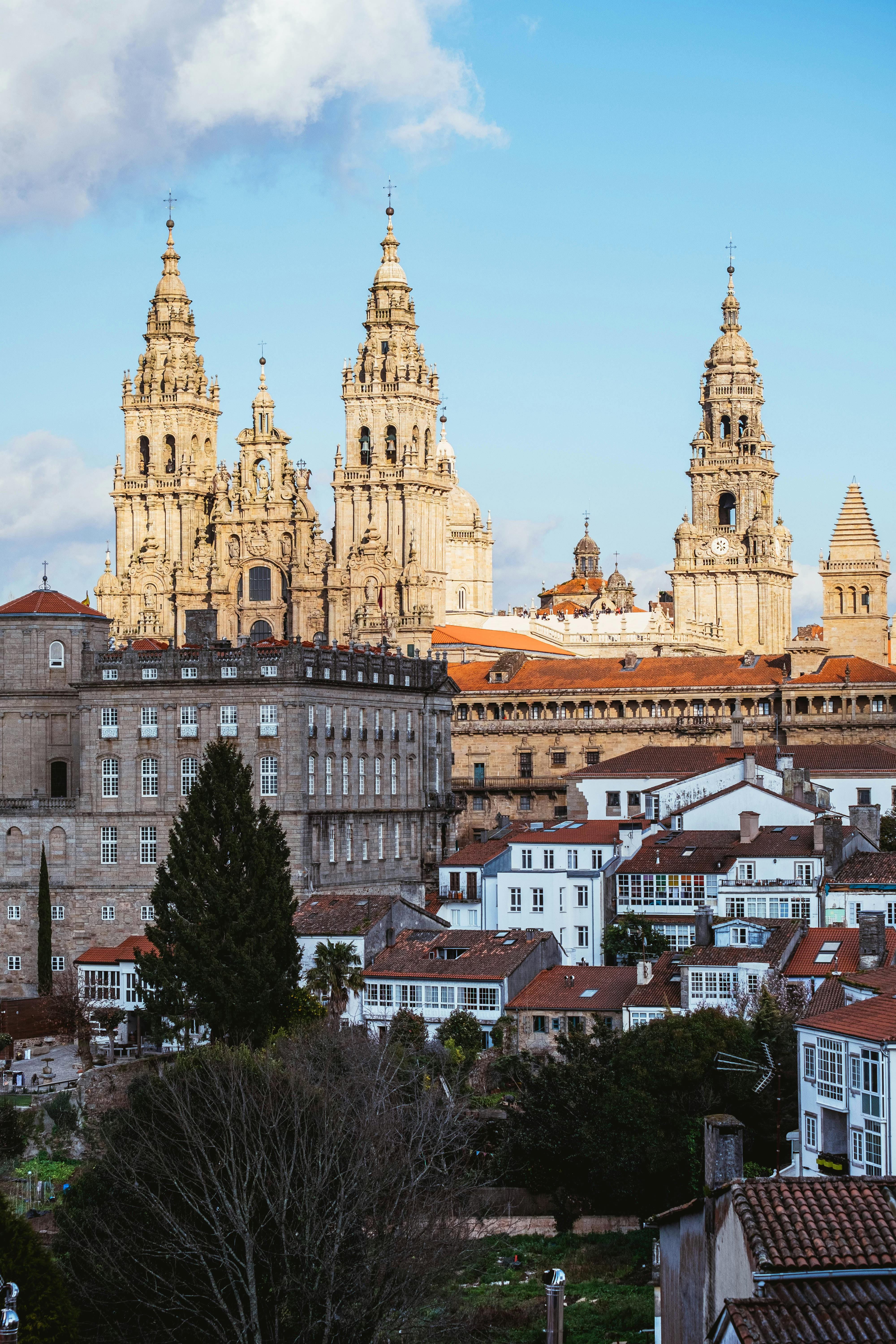
Fellow Galiciefarers, honestly, we just kinda winged it.
“¿Como? How so?”
You have to pick at some point, don’t you?
I sense you’re uncomfortable. Okay… are you familiar with the term analysis paralysis? I try to avoid that. Also, who are you to judge me? What does reading this far into one of my blog posts say about your mental health? Sure, it’s true that we just picked a city, but that wasn’t without weighing variables. The uncertainty I’m alluding to in this decision was made up for by the fact that my wife and I only brought a few bags when we moved abroad, meaning if we messed up, we could have just picked up and gone someplace else.
Our Plan B was basically “go wherever.” Yep.
Ourense vs. Santiago
As for selecting a city in Galicia, mainly we optimized for the best balance between cost, walkability, and public transit quality. By cutting costs down and simultaneously requiring a considerable baseline of transit access, we narrowed our search between Ourense and Santiago. Ourense is quite compelling. It’s packed with apartments. On a monthly basis, rents there tend to be around 200 € cheaper than those of Santiago, and it’s about thirty minutes closer to Madrid by high-speed rail.
Also, it has hot springs.
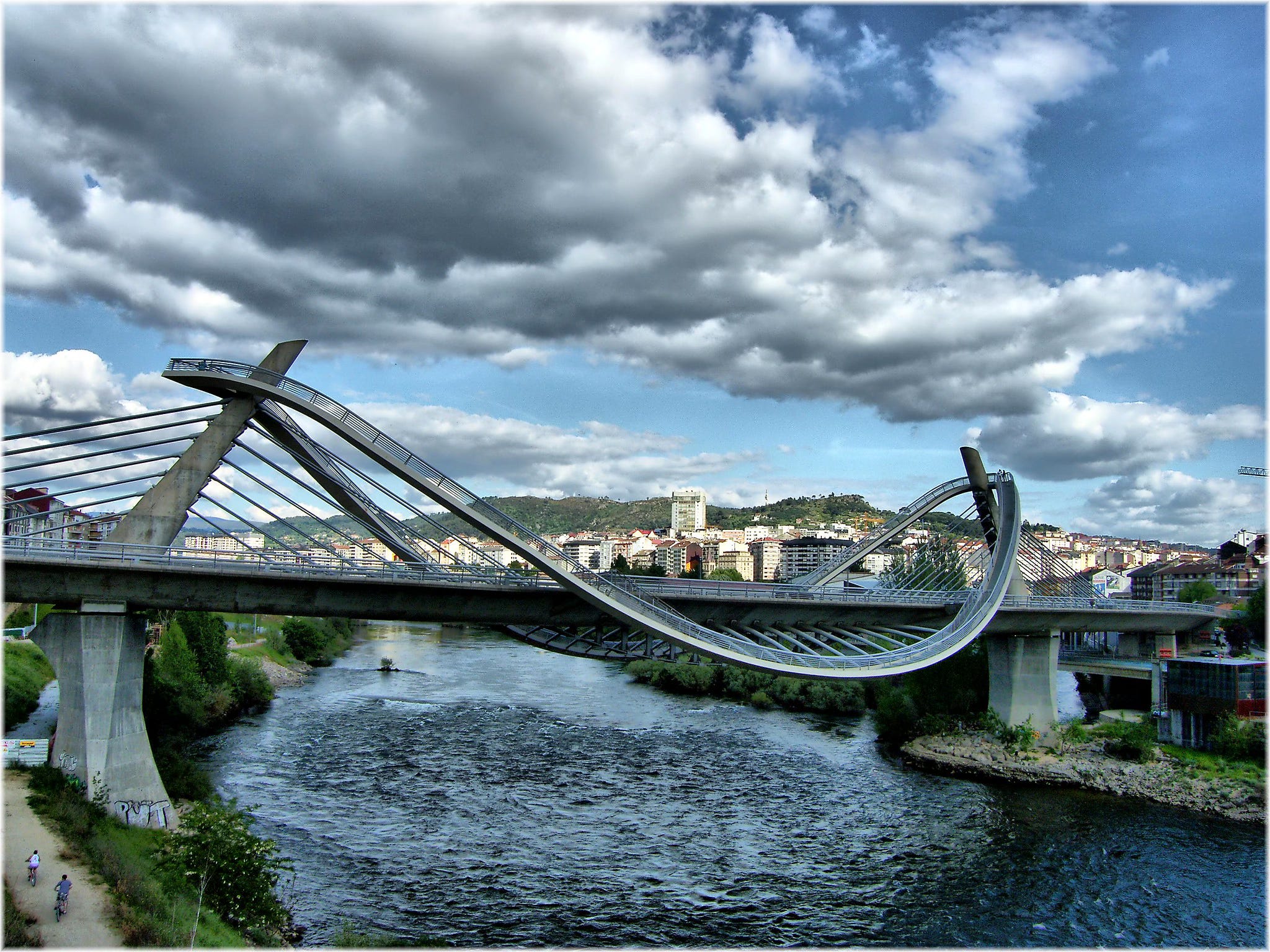

On the flipside, it’s quicker and easier to visit other cities in Galicia from Santiago by train, bus, or taxi. Santiago has more storefronts and cuisine options. There's the airport I already mentioned. Furthermore, its microclimate keeps it cooler than Ourense (just a preference), and more protective against wildfire risk as a result of being nearer the Atlantic coast. As Spain desertifies, wildfires will worsen. This coming summer is a bit worrying considering the historic rains we’ve received this winter. (More rain in the winter means more kindling for the summer.)
Is paying an extra 2,400 € in rent annually to live in Santiago as opposed to Ourense worth it? Well, I certainly can’t answer that question for anyone thinking about moving here. It depends on your means, preferences, and how you actually spend your time after you arrive.
A Coruña vs. Santiago
If we were willing to pay more in rent, A Coruña would’ve been on the table. On average, it’s even cooler there than Santiago, being on the northwestern tip of Spain. It’s Celtic as can be. It has an airport, too. The arts scene there is dynamic and active. I was particularly partial to this city, based on vibes alone, but we couldn’t justify the added “tax” of living on the coast.

This is a flood-prone city, so you have to wonder what climate chaos will mean for its long-term livability.
Vigo vs. Santiago
Vigo is another coastal city with an airport, and though I’ll headbang to some Nine Inch Nails, it’s a tad industrial for my tastes. Its flagship industry is manufacturing automobiles, after all. There’s a lot of great development and initiatives happening there, but it was also more expensive to rent there than Santiago, at least when we were looking. And by the way, these comparisons aren’t comprehensive. The best opportunities are found by detail-oriented scrutiny, not generalities.

But again: coastal city, coastal tax.
Porto (Portugal) vs. Santiago
While not technically in Galicia (or Spain), I’ll mention Porto. It’s where my wife and I originally considered moving abroad before shifting gears to Galicia. It’s a reasonable bus or train ride from Vigo (that will drastically shorten upon completion of the high-speed rail line between them one million years from now). It’s a beautiful Portuguese city at the mouth of the Douro River Valley, but it has a problem. Recently, too many people have moved there all at once. This has rapidly increased cost of living and stoked resentment (Lisbon already had this problem). Spain, in general, differs in its attitude toward those who come here.

Immigrants and emigrants still quite enjoy Porto, but we feel plenty welcome where we’ve landed in Spain. Spaniards typically exhibit nuanced views about travel and immigration. Their bone to pick is with rent-seeking landlords who buy up homes to rent out. By and large, they’re very kind to mindful visitors, immigrants, and emigrants.
Reflections & concluding thoughts
Some months ago, an angstier version of myself concluded the following:
I cannot comprehensively enumerate every single mutually consistent axiom as to why we moved, because they’re surprisingly difficult to parse in retrospect. When you invite a singularity into your life, there’s gravitational lensing involved.
I stand by that statement, although the rest of that post is… a lot. As intense as it may be, it’s at least honest. The “culture relief” I’ve experienced since stepping outside Madrid–Barajas Airport has chilled me out. I still have my moments, but overall… I’m changing more rapidly than I anticipated. How so? More and more, an inner stillness accompanies me wherever I go, whatever I do. It’s strange, frankly.
And as sprawling as this post may seem, there are yet other reasons we moved abroad, not even counting ones we’ve retroactively accrued.

To wrap up the practicalities: there are plenty of other places to choose from in Galicia, such as Lugo with its pristine tract of still-standing Ancient Roman walls. However, high-speed transit and central access to Galicia itself were of utmost importance to my wife and me. We knew if Santiago wasn’t right for us, we could at least easily explore alternatives from the city. Thankfully, we’ve come to love it here — and we’re a short trip away from the aforementioned cities. Our emphasis on walkability, transit access, and centrality meant that, for us, smaller cities and towns simply didn’t register. I can’t say much more about those until we visit them.
And of course, if we were open to rural life, our plans might have been radically different.
The supporting pillar of our move-abroad logos is urbanism. My wife and I are confident that, at least initially, it’s a boon to integration. Be that as it may, does this rule out an off-grid goat farm in the future? No… it could happen. Shit, I’d move to another solar system if I could. The rate of our disillusionment with other humans and technology has only accelerated over the course of our lives. Nonetheless, we expect that our urban community here in Spain will more than compensate for a long time to come.
Reese here from Bebop Libre: No matter where we land, all of us are but mere crumbs of a cosmic fruitcake that was not cooked long enough. That includes you, me, Diogenes, and Ulv the Viking. If you enjoyed this post: please like, share, and subscribe to help spread the crumbs throughout this universe.