

Spain's 2,500 Miles of High-Speed Rail: The Most in Europe — and Cheapest to Build.
What taxation with representation can mean for you.

Part of Bebop Libre’s Spainfrastructure series. 🚆
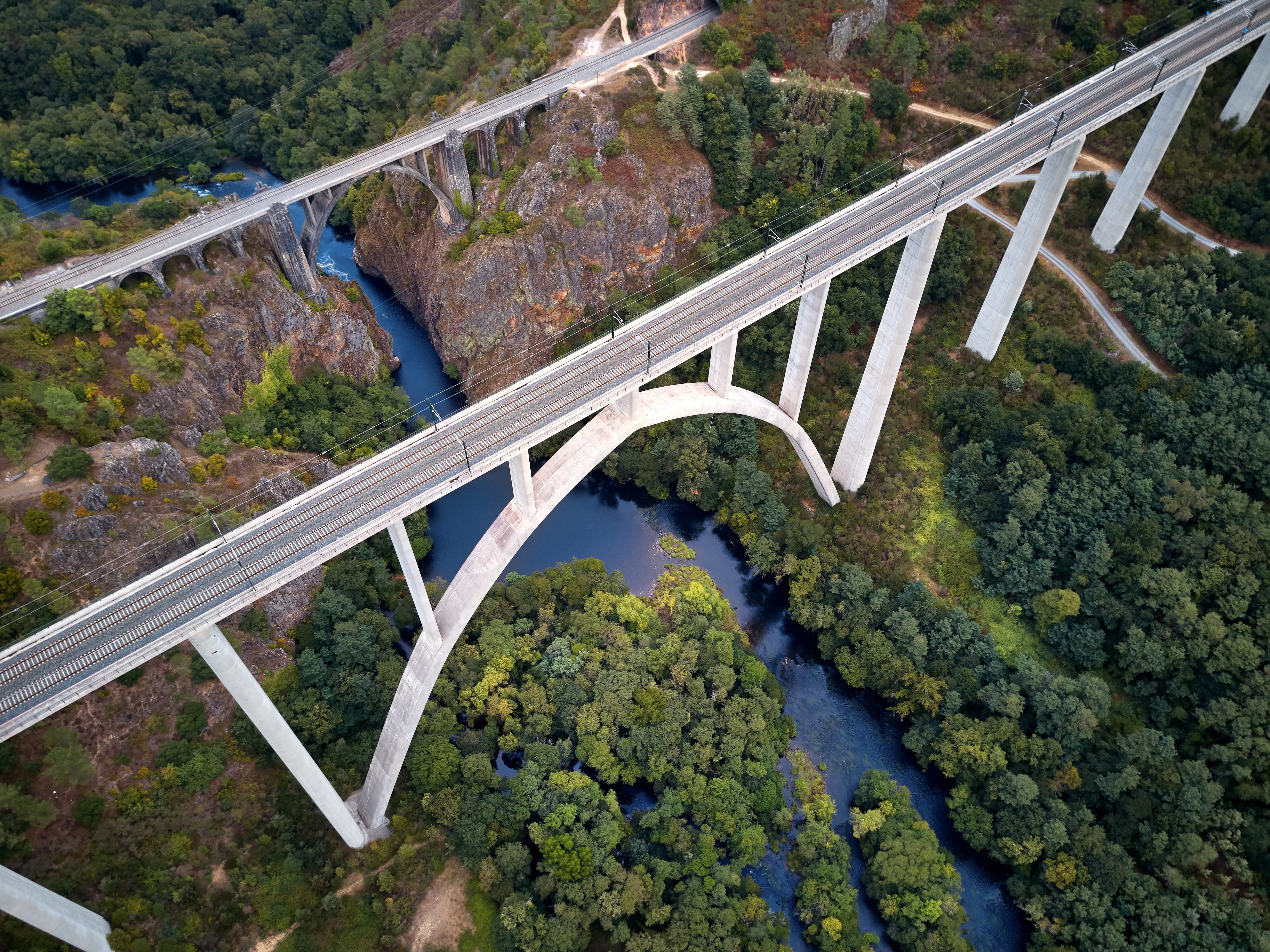
.jpg)
Cold pepperoni pizza empanada. 186 MPH. Saturday morning. Spain.
Yes, I knowingly smuggled an invasive species of food on the last leg of my move to Santiago de Compostela in September 2025. On a tourist visa. I’m a dumb American, okay?
American horror story.
Dozens of times before Spain, I took the Amtrak between Carbondale and Chicago, Illinois. It’s about 310 miles.1 We’d stop for freight almost every trip. Once, the engine failed. Six to seven hours was normal, five and a half if lucky (or by car 🤷♀️). Rudeness, weirdness, or discomfort guaranteed. And that didn’t include the walk between stations in Chicago, the hour-long wait when Amtrak ran late, the Metra connection to Palatine, or the drive home from there.2
I lived in the Chicago suburbs to be near in-laws, not because I had, like, a choice.
Did you know? Telling people you’re from “Chicagoland” sounds more dignified than “strip mall purgatory punctuated by the Portillo’s hot dog chain.”
Anyway. High-speed rail between Madrid and Santiago.
Despite tearing through mountains, it’s nearly the same distance, and typically takes just over three hours.3 There’s more legroom and space for belongings. The Wi-Fi actually works. The doors between cars open automatically, so one need not contract virulent E. coli by fiddling with a handle or button. There are no mystery stains in the bathroom. Around the vending machines between cars, passengers form steering committees to deliberate over culinary options. And on Spanish rail, I’ve never even had strangers threateningly murmur to themselves about me for not letting them borrow my phone.
Each year, residents of “the wealthiest country in the world” celebrate their freedom by lighting red, white, and blue bottle rockets in precarious proximity to their reproductive futures. Perhaps this is also an opportunity to reflect on their car dependency, crumbling parking lots, sidewalks going nowhere, and nonexistent high-speed rail. I should qualify: Amtrak’s Acela serving the Northeast Corridor can reach 150 MPH for short stretches.4 By technicality, it barely qualifies as “high-speed” serving 2% of the landmass containing a measly 15% of the population. Better than nothing, I suppose.5
What’s the major malfunction for rail in America, anyway?
Well, let’s contrast with the AVE — Alta Velocidad Española, or “Spanish High Speed,” though the acronym also conveniently means “bird.”
Public investment consensus.
Modern Spain was forged by Felipe González’s PSOE government — the Partido Socialista Obrero Español, or Spanish Socialist Workers’ Party — and its push toward European integration. The González period from 1982 to 1996 was characterized by the urgent and utilitarian desire to leave an autocratic, inequitable, and relatedly inefficient past behind. Spain’s accession to the European Economic Community in 1986 validated democratic legitimacy previously in question.
While the center-right Partido Popular (PP) — People’s Party6 — criticized initiatives as opposition parties do, the broader direction of European integration and infrastructure investment achieved consensus.
High-speed rail planning began with a decidedly European standard-gauge (1,435 mm) rather than traditional Iberian gauge (1,668 mm) in 1987 for a couple of reasons.7 One, compliance with parameters for high speeds. Two, potential border-crossing between Spain and France. This was later realized from 2010 to 2013 with the Perpignan-Figueres cross-border line.8 Barcelona to Paris by rail is therefore under seven hours of gorgeous scenery.9
But, let’s not get ahead of ourselves by accidentally moving to France.
In 1992, the Seville-Madrid AVE inauguration intentionally coincided with the Seville World Expo. The Summer Olympics, hosted in Barcelona, followed a couple of months later. It was Spain’s time to exhibit its “Europeanness.” Since then, it’s taken about three decades to develop the longest high-speed rail network in Europe, second globally to China.10 A blip in the grand scheme of things.
But politically? That’s an infinity, at least from my American perspective. When the PP took the reins in 1996, they didn’t derail the high-speed rail effort; they took the ball and ran with it. My American intuition of “right-wingers” is that they pathologically tapdance on the decaying public investments they’ve bludgeoned to a pulp and impeded from resuscitation at every opportunity, but that’s — to my surprise — not the PP’s legacy, and furthermore exemplifies how far to the right American politics has moved compared to the rest of the world.
Apart from their recent courting of far-right Vox voters, the PP has, for quite some time, operated within systems that would make most American Democrats blush: universal healthcare, labor protections, higher education, parental leave, the social safety net, and public transit. They didn’t set the stage for most of it, and they’ve certainly tried to trim some muscle along with the fat. But credit where it’s due: they’ve governed in deference to the Spanish Constitution which mandates much of this “general welfare.”11
If only Democrats and Republicans could take the US Constitution as seriously. To start with, how about its preamble?12
We the People of the United States, in Order to form a more perfect Union, establish Justice, insure domestic Tranquility, provide for the common defence, promote the general Welfare [my emphasis], and secure the Blessings of Liberty to ourselves and our Posterity, do ordain and establish this Constitution for the United States of America.
Welfare isn’t free money for undeserving poors to spend on soda and Cadillacs, as certain projection-prone voters have foamed at the mouth about since Reagan; no, it’s the glue of “a more perfect Union.” Who are the welfare queens, anyway? American city-dwellers disproportionately fund rural and suburban sprawl — only solvent by building more sprawl — and in the process doom urban planning and public transit.13
There are, unsurprisingly, echoes of “no taxation without representation” right around the 250th anniversary of my home country.
But, back to Spain: the PSOE and PP have swung back and forth like a pendulum since the European integration that accelerated in the late 80s. Nonetheless, they’ve both supported high-speed rail. It was built at substantially lower cost compared to that of other developed nations. According to a 2023 report, €17.7 million per kilometer in Spain versus €45.5 million elsewhere.14
Taxation with representation: Domestic funding has accounted for around 75% of Spanish high-speed rail. The remaining 25% originated from the EU.15 From 2000 to 2017, nearly half of EU high-speed rail funding was allocated to Spain.16 The disproportionate allocation is due to a highfalutin political theory known as “the early bird gets the worm.” Want funding as a member state? You have to not only aggressively ask for it, but you must be prepared to front most of the bill.
The low cost of Spain’s rail has much to do with urban density. As explained by CityMonitor, “the ‘lived density’ for Spain is in fact 737 people per km² . . . Spain could claim to be the most densely populated major European country by this measure . . . “ An analysis of the country's lived density would kaleidoscope into a whole thing, one I plan to explore separately.
In short, the peculiar quality of being rurally hollow has been most favorable for high-speed rail, but it didn’t build itself.
2,500 miles of not fucking it up.
Some have argued that the Madrid-Galicia route I used to move to Spain, cold empanada in tow, was a political vanity project. Yet, just four years after completion in 2021, its ridership exceeded passenger air transport between Madrid and Galicia for the first time.17 This coincided with the completion of Santiago’s intermodal, a station combining train and bus services.18 (What a fantastic case study in “if you build it, they will come,” and an absolute indictment of what holds America back.)
Around that same time, the network once dominated by the state operator Renfe, was opened to private competition (Ouigo, Iryo) by EU mandate.19 The result? Lower fares, plus fees from other operators.20
Anti-monopoly liberalization was invoked after first architecting a level playing field for both rail and telecom, hence why Spain has some of the best fiber optic infrastructure in the world. Thus follows a lesson for Americans: public investment and market competition need not be warring religions. They can be phased with vigilant oversight.
I stress vigilant oversight, as opposed to opening the door to regulatory capture. To illustrate, Spain recently bought back a 10% stake in Telefónica — the once majority state-owned telecom company — for which major privatization began under the González period. Why? A Saudi Arabian entity built a curious and substantial “private” financial stake in the historical state monopoly.21
The implications: Control of public networks — rail, internet infrastructure, and the like — by profit-seekers is no bueno, but opening regulated access on those networks to competing operators can yield marginal efficiencies.
It’s hard to argue against what Spain has accomplished. As of 2026, there are approximately 2,500 miles of high-speed rail connecting 46 stations.22 This system is a vastly overlooked force multiplier of economic activity, carrying hundreds of millions of passengers every year.23 I look forward to riding it on many future, jolly adventures.
I’ll conclude by acknowledging Spain’s car-free infrastructure is extreme even by European standards. With that in mind, I’ll come clean about my true feelings… everything I said was a lie. Do NOT move to a country that values public investment like I did. This is the biggest mistake I’ve ever made in my entire life.
Now that I’m a “europoor” in a modest apartment, I’ve no yard, only pristine parks, trails, and pilgrims’ ways I’m forced to share with the other people who exist. Coexistence… it’s excruciating. When I need to travel far, I must suffer being chauffeured on a train, faster than I could ever drive, in unparalleled comfort. I miss the need to stop for a Mountain Dew-carbonated piss at a truck stop, alone and vulnerable, where congregating meth heads thoughtfully contemplate petty theft and assault. That’s my safe space. Without a car sitting idle 99% of the time, who even am I?
Reese here. I’m the guy who wrote this post, for some reason. I’m a normal person who moved from America to Spain. Sometimes I talk about infrastructure and its intersection with politics, economics, and history. At other times: bizarro monologues and whimsical fuckery. Subscribe to Bebop Libre if you can dig it.
Amtrak Service in Carbondale, IL, Rail Passengers Association (accessed January 3, 2026)
One time, my wife’s ride on the same Amtrak line halted for a couple of hours after one patron threatened another with a gun — America, fuck yeah.
Santiago de Compostela to Madrid by Train, Trainline (accessed January 3, 2026)
Amtrak Increasing Speed of Acela Trains in New Jersey Through Infrastructure Investments and Improvements, Amtrak Media (June 14, 2022)
Northeast megalopolis, Wikipedia (accessed January 3, 2026)
The Alianza Popular (People’s Alliance) and smaller parties were folded into the Partido Popular (People’s Party or Popular Party) in 1989.
Madrid - Seville Line, Adif Alta Velocidad (February 24, 2021)
Perpignan – Figueres link inaugurated, Railway Gazette International (January 27, 2011)
Paris to Barcelona by Train, The Man in Seat Sixty-One (accessed January 3, 2026)
Recent Developments in Spain’s High-Speed Rail Network: Technical Overview by Roberto Rodríguez and Joaquín Botella, SENER (July 11, 2024)
Spanish Constitution, Senate of Spain (February 19, 2024)
Constitution of the United States, U.S. Senate (accessed January 3, 2026)
The Growth Ponzi Scheme: A Crash Course by John Pattison, Strong Towns (August 28, 2020)
Spain produces the most efficient high-speed in the world, ineco (November 6, 2023)
A European high-speed rail network: not a reality but an ineffective patchwork, European Court of Auditors Special Report No. 19 (2018), p. 15
Cada nuevo dato que conocemos del AVE en España apunta en la misma dirección: le está ganando la partida a Barajas by Alberto de la Torre, Xataka (July 23, 2025)
El edificio principal de la intermodal de Santiago, listo para mover a 4 millones de viajeros by S. Lorenzo, La Voz de Galicia (accessed January 3, 2026)
Celebrating 2021 Year of Rail: liberalisation for high-speed rail travel begins in Spain, European Rail Infrastructure Managers (May 10, 2021)
Spain begins the second phase of liberalisation process, RailwayPRO (October 31, 2024)
Spain concludes purchase of 10% stake in Telefonica, Reuters (May 20, 2024)
General Information, Adif Alta Velocidad (December 22, 2025)
Renfe Carries Record 277.4 Million Passengers in First Half of 2025 by Tiana May, Railway-News (July 18, 2025)
Great post, Reese. Thanks for your appreciation of my country.